

A Roth IRA lets you invest after-tax dollars and withdraw them tax-free in retirement. A Traditional IRA may reduce your taxable income now, but you pay taxes when you pull money out. For most beginners earning a modest salary, the Roth is the stronger default choice because your tax rate is likely lower today than it will be decades from now.
What Is the Core Difference Between a Roth and Traditional IRA?
The fundamental difference is when you pay taxes. With a Roth IRA, you contribute money you have already paid taxes on, and qualified withdrawals in retirement are completely tax-free. With a Traditional IRA, contributions may be tax-deductible now, but every dollar you withdraw in retirement gets taxed as ordinary income.
Think of it this way: a Roth IRA is paying the restaurant bill upfront. A Traditional IRA is running a tab you settle decades later. The IRS reports that both account types share the same annual contribution limit. For the current tax year, that limit is $7,500 if you are under 50, and $8,600 if you are 50 or older.
Neither account type is inherently better. The right pick depends on where you are financially right now and where you expect to be when you retire. Read our research methodology for how we evaluate these decisions.
How Do Contribution Limits and Eligibility Work?
Both Roth and Traditional IRAs share the same annual contribution cap set by the IRS: $7,500 for those under 50 and $8,600 for those 50 and older (current tax year). But Roth IRAs have income limits that can reduce or eliminate your ability to contribute directly.
According to the IRS, if your modified adjusted gross income exceeds certain thresholds as a single filer, your Roth IRA contribution limit starts to phase out. Traditional IRAs have no income limit for contributions, but the tax deduction phases out if you or your spouse have a workplace retirement plan and earn above the threshold.
For most beginners who are early in their careers and earning below the Roth phase-out range, this distinction is irrelevant. You qualify for both. The decision comes down to the tax question.
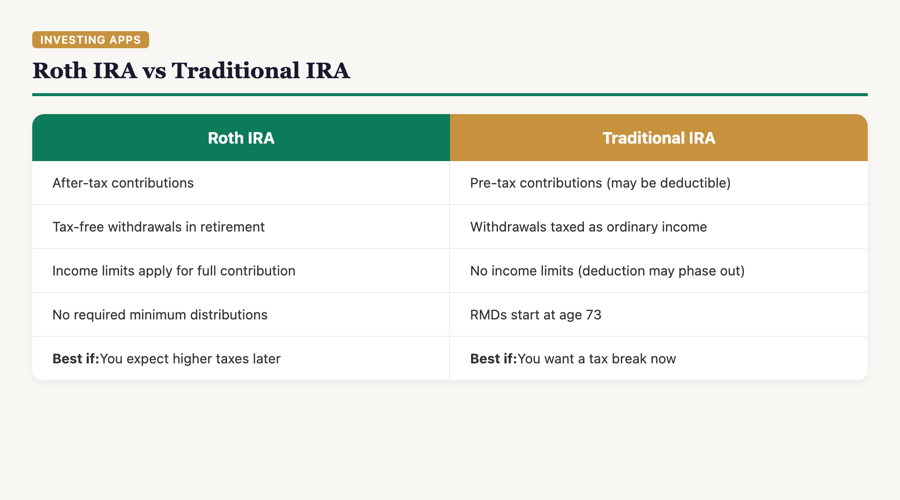
| Feature | Roth IRA | Traditional IRA |
|---|---|---|
| Tax on contributions | After-tax dollars (no deduction) | May be tax-deductible |
| Tax on withdrawals | Tax-free if qualified | Taxed as ordinary income |
| Contribution limit (under 50) | $7,500 | $7,500 |
| Contribution limit (50+) | $8,600 | $8,600 |
| Income limits | Yes (phase-out for high earners) | No (but deduction may phase out) |
| Required minimum distributions | None during owner’s lifetime | Required starting at age 73 |
| Early withdrawal penalty | Contributions: none. Earnings: 10% + tax before 59 1/2 | 10% + tax before 59 1/2 |
| Best for | Lower earners expecting higher future tax rate | Higher earners wanting a tax break now |
Which IRA Is Better If You Are Just Starting to Invest?
For most beginners, a Roth IRA is the better choice. You are likely in a lower tax bracket now than you will be in retirement, which means paying taxes today at a lower rate and letting decades of growth compound completely tax-free is a mathematical advantage.
Here is the honest opinion: unless you are earning above $80,000 as a single filer and have access to a 401(k) at work, the Roth IRA is almost always the smarter first step. The tax-free growth over 30 to 40 years dwarfs the modest deduction a Traditional IRA gives you at a low income.
Fidelity reports that the average IRA balance for investors in their 20s is under $10,000. At that scale, the tax deduction from a Traditional IRA saves you maybe $1,000 to $1,500 per year. The Roth’s compounding advantage over decades makes that look trivial. For more context on getting started with small amounts, see our guide on how to start investing with just $50.
When Does a Traditional IRA Make More Sense?
A Traditional IRA is the better pick when you are in a high tax bracket today and expect to be in a lower one during retirement. It also makes sense if you need to reduce your current taxable income, or if your income exceeds the Roth IRA contribution limits.
Self-employed workers, freelancers with variable income, and anyone in a peak earning year may benefit from the immediate tax deduction. According to the IRS, the full deduction is available if neither you nor your spouse is covered by a workplace retirement plan, regardless of income.
If you are covered by a workplace plan, the deduction phases out above certain income thresholds. In that scenario, a non-deductible Traditional IRA has almost no advantage over a Roth. You would pay taxes going in and coming out.
Can You Open Both a Roth and Traditional IRA?
Yes, you can contribute to both a Roth IRA and a Traditional IRA in the same year. However, your combined contributions to both accounts cannot exceed the annual limit ($7,500 under 50, $8,600 if 50 or older). The IRS tracks the total across all your IRAs.
Splitting contributions between both types is a valid tax diversification strategy. It gives you a pool of tax-free money (Roth) and a pool of tax-deferred money (Traditional) in retirement, which provides flexibility for managing your tax bill year to year.
Most beginners are better off keeping it simple: pick one type, max it out, and revisit the split once your income and tax situation become more complex.
Which Investing Apps Let You Open an IRA?
Most major investing apps now offer both Roth and Traditional IRAs with no account minimums. Fidelity, Charles Schwab, and Vanguard are the established names. Betterment and Wealthfront offer automated IRA management with robo-advisor features.
Betterment charges a management fee of 0.25% per year with no minimum balance, according to their pricing page. Fidelity and Schwab charge no advisory fees for self-directed IRAs. For a full comparison, see our best investing apps for beginners guide.
The app you choose matters less than starting. S&P Global’s SPIVA research shows that over 90% of actively managed large-cap funds underperform the S&P 500 over 20 years. A simple index fund inside any of these IRAs will outperform most professional stock pickers.
What About a Roth 401(k) vs. a Roth IRA?
A Roth 401(k) and a Roth IRA both offer tax-free withdrawals in retirement, but they differ in contribution limits, employer matching, and flexibility. If your employer offers a Roth 401(k) with a match, contribute enough to get the full match before opening a Roth IRA.
The Roth 401(k) has a much higher contribution limit than the Roth IRA. But the Roth IRA gives you more investment choices and no required minimum distributions during your lifetime.
The ideal sequence for most beginners: get the employer 401(k) match first, then max out a Roth IRA, then go back and fill the 401(k). This gives you the best combination of free money, tax-free growth, and investment flexibility. For more strategies on how to start with limited funds, read our guide on the best ETFs for beginners.
Frequently Asked Questions
Can I switch from a Traditional IRA to a Roth IRA?
Yes. This is called a Roth conversion. You pay taxes on the converted amount in the year you convert, but all future growth and qualified withdrawals are tax-free. It makes sense when you are in a low tax bracket.
What happens if I contribute more than the annual limit?
The IRS charges a 6% excess contribution penalty each year the overage remains in the account. You can fix this by withdrawing the excess plus any earnings before your tax filing deadline.
Can I withdraw Roth IRA contributions early without penalty?
Yes. You can withdraw your contributions (not earnings) from a Roth IRA at any time, for any reason, with no taxes or penalties. Earnings withdrawn before age 59 1/2 face a 10% penalty plus taxes.
Do IRAs have required minimum distributions?
Traditional IRAs require minimum distributions starting at age 73. Roth IRAs have no required minimum distributions during the original owner’s lifetime, making them a powerful estate planning tool.
Is my IRA protected if the brokerage goes bankrupt?
SIPC protects brokerage accounts (including IRAs) up to $500,000 in securities and $250,000 in cash if a brokerage fails. Your investments are also held separately from the brokerage’s own assets.
How do I open an IRA as a complete beginner?
Choose a brokerage app, select Roth or Traditional IRA, provide your Social Security number and employment information, fund the account with a bank transfer, and pick an investment (a total market index fund is a solid default).
Sources
- IRS — IRA Contribution Limits (checked when I last reviewed)
- IRS — Roth IRAs
- IRS — Traditional IRAs
- Betterment — Pricing Page
- S&P Global — SPIVA U.S. Scorecard
- SIPC — Securities Investor Protection Corporation
MyMomToken.com is not a registered investment advisor, broker-dealer, or tax professional. This content is for educational purposes only and does not constitute financial or tax advice. Consult a qualified professional for advice specific to your situation.