The best ETFs for beginners are broad-market index funds with low expense ratios that track the entire U.S. stock market or the S&P 500. A single total-market ETF like VTI or a single S&P 500 ETF like VOO gives instant diversification across hundreds or thousands of companies for an annual fee under 0.10%. You do not need to pick individual stocks, time the market, or understand complex strategies. One fund, bought regularly, is a complete beginner investing plan.
The S&P SPIVA scorecard, published by S&P Global, reports that over 90% of actively managed large-cap funds underperformed the S&P 500 over a 20-year period. That single statistic is the strongest case for index ETFs: if professional fund managers cannot consistently beat the index, a beginner should not try either. Instead, buy the index. An ETF (exchange-traded fund) makes that possible for the cost of a single share, or even a fraction of one. Here is how to choose, based on our research methodology.
What Is an ETF and How Is It Different from a Stock?
An ETF is a basket of investments that trades on a stock exchange like a single stock. When you buy one share of an S&P 500 ETF, you own a tiny slice of all 500 companies in that index. Buying one share of Apple stock means you own a tiny piece of one company. The ETF spreads your risk across hundreds of companies automatically.
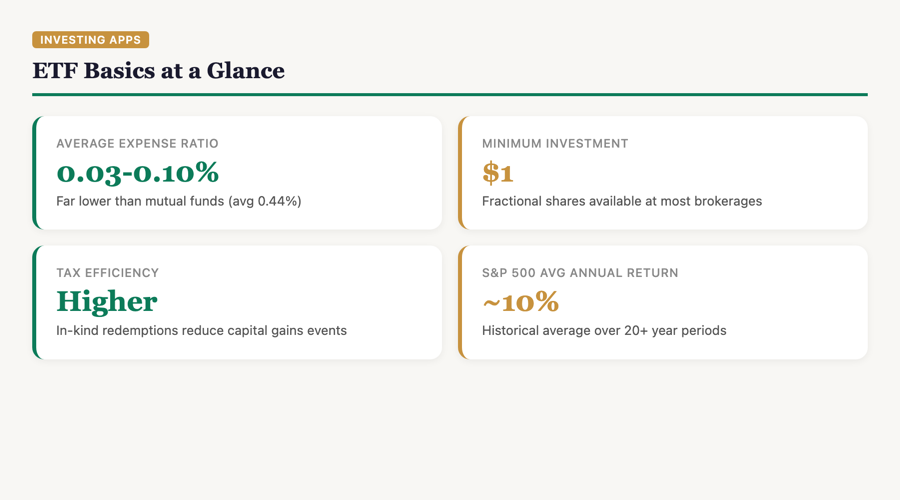
ETFs differ from mutual funds in two practical ways for beginners. First, ETFs trade throughout the day at market prices, while mutual funds trade once per day after the market closes. Second, ETFs typically have lower expense ratios (annual fees) than comparable mutual funds, especially actively managed ones.
The expense ratio is the annual percentage the fund charges for management. A 0.03% expense ratio on a $10,000 investment costs $3 per year. A 1.00% expense ratio costs $100 per year on the same amount. Over decades of compounding, that difference can mean tens of thousands of dollars.
Which ETFs Should a Beginner Start With?
For most beginners, one or two broad-market ETFs is the entire portfolio. Here are the most commonly recommended starter ETFs, all from major providers with long track records:
| ETF | Tracks | Expense Ratio | Number of Holdings | Best For |
|---|---|---|---|---|
| VTI (Vanguard Total Stock Market) | Entire U.S. stock market | 0.03% | ~3,600+ | Broadest U.S. diversification in one fund |
| VOO (Vanguard S&P 500) | S&P 500 index | 0.03% | ~500 | Large-cap U.S. exposure, most popular beginner ETF |
| VXUS (Vanguard Total International) | Non-U.S. stocks | 0.08% | ~8,500+ | International diversification paired with VTI or VOO |
| BND (Vanguard Total Bond Market) | U.S. investment-grade bonds | 0.03% | ~10,000+ | Stability and income for conservative allocation |
| SCHD (Schwab U.S. Dividend Equity) | High-dividend U.S. stocks | 0.06% | ~100 | Income-focused investing, reliable dividend payers |
| QQQ (Invesco Nasdaq 100) | Nasdaq 100 index | 0.20% | ~100 | Tech-heavy growth exposure |
My honest recommendation for a true beginner: start with VTI or VOO alone. Do not overthink the portfolio. A single total-market fund is more diversified than most professionally managed portfolios. Add international exposure (VXUS) later if you want it. Add bonds (BND) as you get closer to needing the money.
How Much Money Do You Need to Buy an ETF?
Most major investing apps now support fractional shares, which means you can buy a piece of an ETF for as little as $1. You do not need to buy a full share. If VOO trades at roughly $450 per share, you can buy $50 worth and own about one-ninth of a share.
Fractional share support is available on Fidelity, Charles Schwab, Robinhood, and most other beginner investing apps. The minimum varies by platform. Some require $1, others $5. None of the major platforms charge a commission for buying or selling ETFs.
The practical minimum to start is whatever you can invest consistently. Even $25 per week into a single index ETF, invested for 30 years at the stock market’s historical average return, grows significantly through compound interest. Consistency matters more than the starting amount. See our guide on how to start investing with $50 for the step-by-step.
What Is the Difference Between an S&P 500 ETF and a Total Market ETF?
An S&P 500 ETF holds the 500 largest U.S. companies by market capitalization. A total stock market ETF holds those same 500 companies plus thousands of mid-cap and small-cap companies. In practice, the performance difference is small because the large companies dominate both indexes by weight.
Over most historical periods, VTI and VOO have tracked within a fraction of a percentage point of each other. The total market fund (VTI) has slightly more exposure to small and mid-cap companies, which can outperform or underperform large caps depending on the market cycle.
For a beginner, the choice between VTI and VOO is not worth agonizing over. Pick one and start. Switching later is easy and has no practical downside. The important decision is investing in a broad index at all, not which broad index.
How Do ETF Expense Ratios Affect Long-Term Returns?
Expense ratios compound over time, just like investment returns. A seemingly small difference in fees creates a large difference in wealth over decades. Here is a concrete example using a $10,000 initial investment growing at 8% annually over 30 years:
| Expense Ratio | Annual Cost (Year 1) | Portfolio After 30 Years | Total Fees Paid |
|---|---|---|---|
| 0.03% (VTI/VOO) | $3 | ~$99,900 | ~$900 |
| 0.20% (QQQ) | $20 | ~$94,600 | ~$6,200 |
| 0.50% (average active ETF) | $50 | ~$86,500 | ~$14,300 |
| 1.00% (high-fee mutual fund) | $100 | ~$76,100 | ~$24,700 |
The difference between a 0.03% fund and a 1.00% fund is nearly $24,000 on a single $10,000 investment over 30 years. That is money lost to fees that could have been compounding in the portfolio. This is why virtually every financial advisor recommends low-cost index funds for beginners.
Should You Buy ETFs Through an App or a Traditional Brokerage?
For beginners, mobile investing apps like Fidelity, Schwab, and Robinhood offer the same ETFs at the same prices as traditional brokerage accounts. The ETF itself is identical regardless of where you buy it. VOO bought on Robinhood is the same VOO bought through a Vanguard brokerage account.
The differences are in the surrounding features. Fidelity and Schwab offer research tools, retirement accounts (IRAs), and human financial advisors. Robinhood has a simpler interface but fewer educational resources. For a beginner buying one or two index ETFs, the platform matters less than actually starting.
If you plan to open a Roth IRA, choose a platform that supports retirement accounts. Robinhood added IRA support, but Fidelity and Schwab have deeper retirement planning tools. For a taxable brokerage account (no retirement tax advantages), any major platform works.
What Are the Risks of Investing in ETFs?
ETFs that track stock indexes will lose value when the stock market declines. A total-market ETF lost roughly 34% during the March 2020 COVID crash and roughly 25% during the 2022 bear market. Both times, it recovered and reached new highs within one to two years.
The risk of a broad index ETF is the risk of the stock market itself. You are not risking money on a single company. You are risking it on the entire U.S. economy (for a U.S. total market fund) or the 500 largest companies (for an S&P 500 fund). Historically, both have trended upward over every 20-year period in modern market history.
The practical risk for beginners is behavioral, not financial. Selling during a downturn locks in losses. Buying consistently through downturns (dollar-cost averaging) means you buy more shares at lower prices. The biggest enemy of beginner investors is panic selling, not market risk.
Frequently Asked Questions
Can I lose all my money in an ETF?
It is theoretically possible but practically impossible with a broad-market index ETF. For VTI or VOO to go to zero, every company in the U.S. stock market or the S&P 500 would have to become worthless simultaneously. Individual stock ETFs or sector ETFs carry more concentrated risk.
How often should I buy ETFs?
Set a regular schedule (weekly, biweekly, or monthly) and invest the same amount each time regardless of market conditions. This is called dollar-cost averaging. It removes the pressure of timing the market and builds discipline.
Do ETFs pay dividends?
Yes. Most stock ETFs distribute dividends from the underlying companies, typically quarterly. You can reinvest dividends automatically (called DRIP) to buy more shares, which compounds your returns over time.
What is the difference between ETFs and index funds?
An index fund can be either an ETF or a mutual fund. The term “index fund” describes the strategy (tracking an index), while “ETF” describes the structure (exchange-traded). Vanguard offers VTI as an ETF and VTSAX as a mutual fund — both track the same index with the same expense ratio.
Should I buy VOO or VTI?
Either one is an excellent choice for a beginner. VTI is slightly more diversified (total market vs. large-cap only). VOO is slightly more concentrated in the largest companies. Their long-term performance is nearly identical. Pick one and stay consistent.
Sources
- S&P Global — SPIVA U.S. Scorecard (90%+ active managers underperform), spglobal.com (verified when this article was last reviewed)
- Vanguard — ETF Product Pages (VTI, VOO, VXUS, BND), investor.vanguard.com
- SEC — Investor Bulletin: Exchange-Traded Funds, sec.gov
- Schwab — ETF Research and Comparison Tools, schwab.com
MyMomToken.com is not a broker, financial advisor, or investment company. This guide is for educational purposes only. Past performance does not guarantee future results. See our research methodology and disclaimer.