
Venmo is safe for selling on Facebook Marketplace only if you use the goods and services payment option, which activates Purchase Protection. Personal payments between friends have zero buyer or seller protection. When I last checked, Venmo charges the seller a 1.9% + $0.10 fee for goods and services transactions. If a buyer sends a personal payment instead, neither party has recourse if something goes wrong. The single most important step is insisting on the goods and services tag for every sale.
Facebook Marketplace does not have its own built-in payment system for most local sales. That leaves buyers and sellers negotiating payment through Venmo, Zelle, Cash App, or cash. Venmo is the most commonly suggested option in Marketplace listings, but the safety depends entirely on which type of Venmo payment is used. The distinction between personal and business payments is the difference between having protection and having none. Here is what the Venmo terms actually say, based on our direct review of the payment platforms.
What Is the Difference Between Personal and Goods and Services Payments on Venmo?
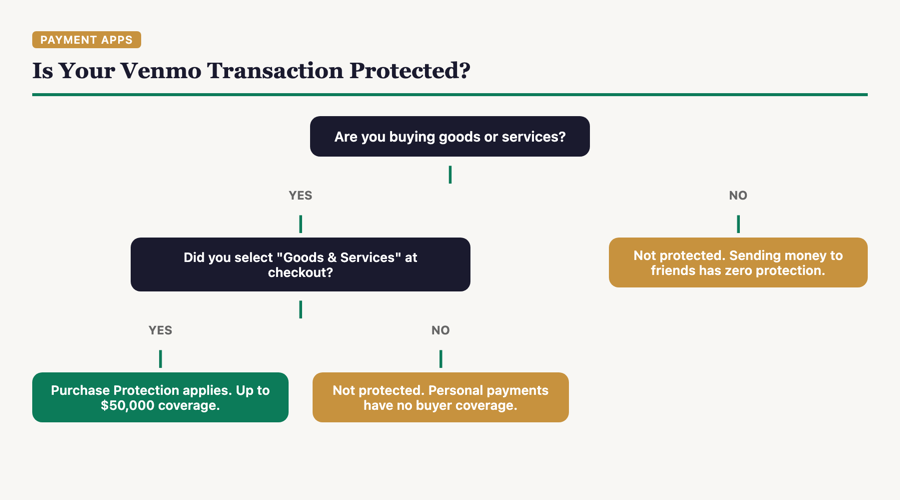
Personal payments are designed for sending money to friends and family: splitting dinner, paying back a loan, sending a gift. They have no buyer or seller protection. Once the money is sent, it is gone. Venmo will not reverse a personal payment even if the product is never delivered or turns out to be fake.
Goods and services payments activate Venmo Purchase Protection. When a buyer tags a payment as a purchase, Venmo covers eligible items if they are not received, are significantly different from the description, or are damaged. The seller pays a 1.9% + $0.10 processing fee on each transaction.
| Feature | Personal Payment | Goods and Services Payment |
|---|---|---|
| Buyer Protection | None | Yes (Purchase Protection) |
| Seller Protection | None | Yes (for eligible transactions) |
| Fee | $0 | 1.9% + $0.10 (paid by seller) |
| Dispute Resolution | None | Venmo mediates disputes |
| Refund Possible | Only if recipient voluntarily sends money back | Venmo can issue refunds for eligible claims |
| Best For | Friends, family, trusted contacts | Marketplace sales, strangers, any goods exchange |
The bottom line is clear: if you are selling to a stranger on Facebook Marketplace, always use the goods and services option. The 1.9% fee on a $100 item is $1.90. That is cheap insurance against a fraudulent buyer claim.
What Does Venmo Purchase Protection Actually Cover?
Venmo Purchase Protection covers eligible transactions where the buyer tagged the payment as a purchase. According to Venmo’s terms, coverage applies when an item is not received, is significantly not as described, or arrives damaged. The buyer must file a claim within 180 days of the payment.
For sellers, Purchase Protection covers eligible transactions against unauthorized payments or claims from buyers who received the item as described. The seller needs to provide proof of delivery (tracking number) and proof that the item matched the listing description.
Purchase Protection does not cover vehicles, real estate, custom or made-to-order items, industrial machinery, or anything purchased in person and inspected before payment. It also does not cover personal payments, even if the personal payment was for a product. The tag matters more than the intent.
What Are the Most Common Venmo Scams on Facebook Marketplace?
Scammers exploit the gap between personal and business payments. Here are the patterns that show up most often in consumer complaints:
The overpayment scam. A buyer sends more than the asking price via Venmo and asks the seller to refund the difference. The original payment was made with a stolen credit card or hacked account. When the real account owner disputes the charge, Venmo claws back the full amount, and the seller is out both the item and the “refund” they sent.
The personal payment pressure. A buyer asks the seller to accept a personal payment “to avoid fees.” This strips both parties of protection. If the item has a problem, the buyer has no recourse. If the buyer later claims they never received it, the seller has no documentation through Venmo’s dispute system.
The fake payment screenshot. A buyer shows a screenshot of a Venmo payment confirmation but the money never arrives. Always verify the payment in your own Venmo app before handing over the item. Screenshots can be fabricated in seconds.
The account takeover. A buyer pays with a compromised Venmo account. Days later, the real account owner reports unauthorized activity, and Venmo reverses the payment. The seller loses the item and the money. Goods and services protection helps here because Venmo’s dispute process considers delivery proof.
Is Zelle Safer Than Venmo for Marketplace Sales?
No. Zelle is less safe for marketplace transactions because it has no purchase protection at all. Zelle is designed for sending money to people you know and trust. The transfers are instant and irreversible. Once money is sent through Zelle, neither the sender nor the bank can reverse it in most scam scenarios.
Zelle explicitly states on its website that it should not be used for payments to people you do not know. Facebook Marketplace sales to strangers fall squarely outside Zelle’s intended use case. If a Zelle payment goes wrong, the buyer’s bank will typically decline a fraud claim because the payment was authorized (the buyer chose to send it).
Cash App falls in a similar category. Cash App has no purchase protection for peer-to-peer payments. For a full comparison of how these platforms differ, see the Venmo vs. Zelle vs. Cash App breakdown.
What Is the Safest Way to Accept Payment on Facebook Marketplace?
For local sales where buyer and seller meet in person, cash remains the safest option. There are no chargebacks, no account disputes, and no processing fees. Meet in a public place (many police stations offer “safe trade” parking lots) and count the cash before handing over the item.
For shipped items or situations where cash is not practical, Venmo goods and services is the best option among peer-to-peer payment apps. The 1.9% + $0.10 fee is the cost of having a dispute resolution process. Factor it into your asking price.
For high-value items (electronics, furniture, anything over $500), consider using Facebook’s checkout system where available, or PayPal Goods and Services, which offers similar protection with a longer track record. The fee structure is comparable.
For more on the broader payment app landscape and which platforms work best for different scenarios, see the full comparison guide.
How Do You File a Venmo Purchase Protection Claim?
If you used the goods and services payment option and something went wrong, open the Venmo app, find the transaction, and tap “Get Help.” Select the reason for the dispute (item not received, not as described, or damaged). Venmo gives the other party a chance to respond before making a decision.
Document everything before filing. Take screenshots of the Facebook Marketplace listing, all messages with the buyer or seller, the Venmo transaction details, and any shipping tracking information. The more evidence you provide upfront, the faster the resolution.
Claims must be filed within 180 days of the payment date. Venmo typically resolves disputes within 30 days but may take longer for complex cases. During the investigation, the disputed funds may be held by Venmo.
Frequently Asked Questions
Can a Venmo payment be reversed after it is sent?
Personal payments cannot be reversed by Venmo. The only way to get money back is if the recipient voluntarily sends it. Goods and services payments can be reversed through the Purchase Protection dispute process if the claim is valid.
Does Venmo charge the buyer or the seller for goods and services?
The seller pays the 1.9% + $0.10 fee. The buyer pays nothing extra. Sellers should factor this fee into their asking price rather than trying to avoid it by requesting personal payments.
Should I accept Venmo for items over $500?
Venmo goods and services provides protection for higher-value items, but the risk scales with the price. For items over $500, consider meeting in person with cash, using Facebook’s built-in checkout where available, or using PayPal Goods and Services which has a longer track record with high-value disputes.
Is it illegal to scam someone on Venmo?
Yes. Payment fraud is a crime regardless of the platform. Victims can report scams to the FTC at reportfraud.ftc.gov, file a police report, and pursue the matter in small claims court. However, recovery is difficult when the scammer is anonymous or uses a fake identity.
Can I use Venmo for selling on other platforms like OfferUp or Craigslist?
The same rules apply. Always use the goods and services option when selling to strangers on any platform. OfferUp has its own payment system for shipped items, which may be safer than using a third-party app. Craigslist explicitly recommends cash for local transactions.
Sources
- Venmo — Purchase Protection Terms, venmo.com (verified when this article was last reviewed)
- Venmo — Common Scams and How to Avoid Them, help.venmo.com
- Zelle — Safe Payment Guidelines, zellepay.com
- FTC — Reporting Fraud, reportfraud.ftc.gov
- PayPal — Q4 2024 Earnings (Venmo active accounts: 90M+), investor.paypal.com
MyMomToken.com is not a payment processor or legal advisor. This guide is for educational purposes. See our research methodology and disclaimer.