

Splitwise is the best overall app for tracking shared expenses with roommates, while Zelle is the fastest for actually sending rent money with no fees. The ideal setup for most roommates is Splitwise for tracking who owes what, paired with Zelle or Venmo for the actual payments. No single app does both perfectly. Here is how the major options compare for splitting rent, utilities, groceries, and household expenses.
Splitting rent with roommates sounds simple until someone forgets a utility bill and the group chat turns hostile. According to a Pew Research survey, money disagreements are among the top sources of conflict in shared living situations. The right app removes the math and the awkwardness. But different apps solve different parts of the problem: some track expenses, some transfer money, and a few try to do both. Here is what actually works, based on how we evaluate fintech products.
Which Apps Are Best for Splitting Rent and Bills?
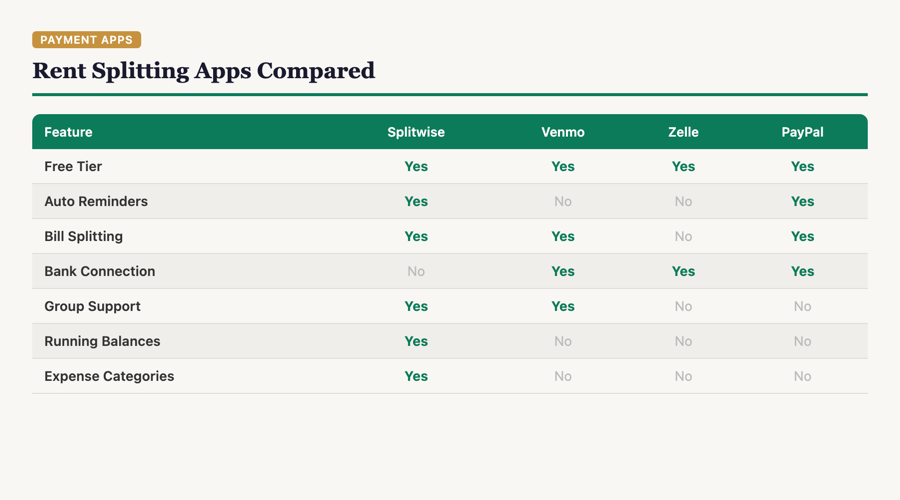
The best rent-splitting setup depends on whether you need expense tracking, money transfers, or both. Splitwise dominates expense tracking. Zelle dominates free instant transfers. Venmo sits in between with social features and a broader merchant network.
| App | Best For | Transfer Fee | Speed | Expense Tracking | Recurring Splits |
|---|---|---|---|---|---|
| Splitwise | Tracking shared expenses | No transfers (tracking only) | N/A | Excellent | Yes |
| Zelle | Free instant bank transfers | $0 | Minutes | None | No |
| Venmo | Social payments with purchase protection | $0 (bank); 1.75% (instant) | 1-3 days (bank); instant (fee) | Basic | No |
| Cash App | Quick peer payments with investing | $0 (bank); 0.5-1.75% (instant) | 1-3 days (bank); instant (fee) | None | No |
| Honeydue | Couples sharing finances | No transfers | N/A | Good (couples-focused) | Yes |
| Bilt Rewards | Earning points on rent payments | $0 (with Bilt card) | Varies by landlord | None | Yes (rent only) |
The table reveals a gap in the market. No single app is great at both tracking shared expenses and transferring money for free. That is why the two-app approach (Splitwise for math, Zelle for payment) works best for most roommate groups.
How Does Splitwise Work for Roommates?
Splitwise tracks shared expenses and calculates who owes whom. It does not transfer money. One roommate enters an expense (say, a $150 electric bill), selects who it should be split among, and Splitwise keeps a running balance. At the end of the month, the app shows the net amount each person owes.
The free version of Splitwise handles unlimited groups and expenses. Splitwise Pro costs $2.99 per month and adds features like receipt scanning, currency conversion, and charts. For basic rent splitting, the free version is sufficient.
Splitwise’s strongest feature for roommates is the “simplify debts” function. In a four-person household where everyone pays different bills, the app reduces the web of debts to the minimum number of transactions. Instead of six separate payments, you might end up with two. This alone prevents most roommate payment confusion.
Is Zelle or Venmo Better for Paying Rent to Roommates?
For paying a roommate directly, Zelle is better because it is free, instant, and deposits directly into the recipient’s bank account. There is no balance to cash out, no waiting period, and no fee. Zelle processed $806 billion in payments in 2023, according to Early Warning Services, the company behind Zelle.
Venmo is better if your roommate group prefers the social feed, wants purchase protection on goods and services, or if someone in the group does not have a Zelle-compatible bank. Venmo has over 90 million active accounts, according to PayPal, making it the most widely adopted payment app among younger users.
The key difference is the fee structure. Zelle charges nothing for any transfer. Venmo charges nothing if you pay from your bank account or Venmo balance, but charges 1.75% for instant transfers to your bank. If a roommate needs money immediately and uses the instant transfer, that fee adds up over a year of rent payments.
For a full head-to-head breakdown of these three platforms, see the Venmo vs. Zelle vs. Cash App comparison.
Can You Pay Your Landlord Directly Through a Payment App?
Some landlords accept Zelle or Venmo. Many do not. The answer depends on your landlord’s payment setup and whether they use a property management platform.
Large property management companies typically use their own online portals (like AppFolio, RentCafe, or Buildium) and do not accept payment apps. Smaller landlords and individual property owners are more likely to accept Zelle. Venmo for Business allows landlords to accept rent payments with Purchase Protection for the tenant.
Bilt Rewards is the only platform specifically designed for rent payments. The Bilt Mastercard lets tenants pay rent with no fees and earn points on the payment. Bilt partners with major property managers including Equity Residential and AvalonBay. For properties not in the Bilt network, the card can still be used to pay rent via ACH through the Bilt app.
What About Splitting Utilities and Groceries?
Rent is usually the largest shared expense, but utilities, internet, groceries, and household supplies add up. The tracking approach matters here because these expenses are irregular and unevenly shared.
Splitwise handles this well. Each roommate logs purchases as they happen, tags the group, and the app tallies everything. At the end of the month (or whenever the group settles up), one net payment covers everything instead of dozens of small transfers back and forth.
For groceries specifically, some roommate groups designate one person to do the shopping each week and rotate. Others split every trip. Splitwise supports both patterns. The receipt scanning feature in Splitwise Pro can itemize a grocery receipt so different items go to different people, which is useful if one roommate is vegetarian and should not split the meat bill.
For broader payment app options beyond rent splitting, see the full payment app comparison guide.
What Is the Best Setup for a New Roommate Group?
Here is the setup that works best based on feedback from financial advisors and personal finance communities:
- Create a Splitwise group with all roommates. Name it after the apartment.
- Add recurring expenses in Splitwise: rent (if one person pays the landlord), utilities, internet, any shared subscriptions.
- Log one-off expenses as they happen: groceries, cleaning supplies, shared meals.
- Settle up monthly using Zelle (free, instant) or Venmo (free from bank, social features).
- Keep a shared document with the WiFi password, utility account numbers, and each person’s Zelle email or Venmo handle.
This approach costs nothing (free Splitwise tier plus free Zelle transfers) and takes about five minutes of setup. It eliminates the “who owes what” arguments because the math is always visible to everyone in the group.
Frequently Asked Questions
Is Splitwise free?
Yes. The free version handles unlimited groups, expenses, and members. Splitwise Pro ($2.99/month) adds receipt scanning, currency conversion, and charts. Most roommate groups do not need Pro.
Can I set up automatic rent splitting?
Splitwise lets you create recurring expenses that automatically log each month. However, the actual payment still needs to be sent manually through Zelle, Venmo, or another transfer method. No app fully automates both the tracking and the transfer for peer-to-peer rent splits.
What if a roommate does not pay their share?
Payment apps cannot force payment. Splitwise keeps a record of the outstanding balance, which serves as documentation. If the situation escalates, that expense log can support a small claims case. Prevent the problem by settling balances monthly rather than letting debts accumulate.
Does paying rent through Venmo or Zelle build credit?
No. Peer-to-peer payments through Venmo, Zelle, or Cash App do not report to credit bureaus. To build credit through rent payments, you need a service that specifically reports to bureaus, like Bilt or a dedicated rent-reporting service.
Are payment app transfers for rent taxable?
Rent payments between roommates are not taxable income for the person collecting and forwarding the payment to the landlord. The IRS requires payment platforms to report transactions over $20,000 in more than 200 transactions for goods and services, but personal payments like rent splits are explicitly excluded from 1099-K reporting, according to the IRS.
Sources
- Early Warning Services — Zelle Network Data, zellepay.com (verified when this article was last reviewed)
- PayPal — Q4 2024 Earnings, Venmo active accounts, investor.paypal.com
- IRS — Understanding Your Form 1099-K, irs.gov
- Splitwise — Pricing and Features, splitwise.com
- Bilt Rewards — Rent Payment Program, biltrewards.com
MyMomToken.com is not a financial advisor or payment processor. This comparison is for educational purposes. See our research methodology and disclaimer for how we evaluate products.