
A secured credit card requires an upfront deposit that becomes your credit limit. A credit builder loan locks your loan amount in a savings account and reports your payments to the bureaus. Both build credit, but a secured credit card builds it faster for most people because it reports utilization data every month in addition to payment history.
How Does a Secured Credit Card Build Credit?
A secured credit card works like a regular credit card except you put down a refundable deposit, typically $200 to $500, which becomes your credit limit. You make purchases, pay your bill on time each month, and the issuer reports your activity to the three major credit bureaus: Equifax, Experian, and TransUnion.
The deposit protects the card issuer if you default. According to the Consumer Financial Protection Bureau, secured cards are designed for people with no credit history or damaged credit who cannot qualify for a traditional unsecured card.
What makes secured cards powerful for credit building is that they report two of the five FICO score factors: payment history (35% of your score) and amounts owed (30% of your score). Keeping your utilization below 30% of your limit while paying on time gives the scoring models two positive signals every month. Learn more about credit building strategies in our guide to building credit with fintech apps.
How Does a Credit Builder Loan Work?
A credit builder loan flips the traditional loan model. Instead of receiving money upfront, the lender deposits the loan amount (usually $300 to $1,000) into a locked savings account. You make fixed monthly payments for 6 to 24 months, and when the loan term ends, you receive the saved funds minus interest and fees.
Each payment gets reported to the credit bureaus as an installment loan payment. This primarily builds your payment history (35% of your FICO score) and adds a new account type to your credit mix (10% of your score).
Companies like Self (formerly Self Lender) and credit unions offer credit builder loans. Self’s plans start at around $25 per month. The total interest paid over the loan term is the cost of building credit this way. For someone with absolutely no credit history, see our guide on how long it takes to build credit from nothing.
Which One Builds Your Credit Score Faster?
A secured credit card typically builds credit faster because it reports both payment history and credit utilization every month. A credit builder loan only reports payment history. Since utilization accounts for 30% of your FICO score, the secured card gives the scoring model more data to work with.
According to myFICO.com, the five factors in your FICO score are: payment history (35%), amounts owed (30%), length of credit history (15%), credit mix (10%), and new credit (10%). A secured card directly influences the two largest factors. A credit builder loan directly influences only the largest one.
In my assessment, a secured credit card is the faster path for most people. You can see score movement in as little as one to two billing cycles if you keep utilization low and pay on time. Credit builder loans take longer to show results because they only add payment history data.
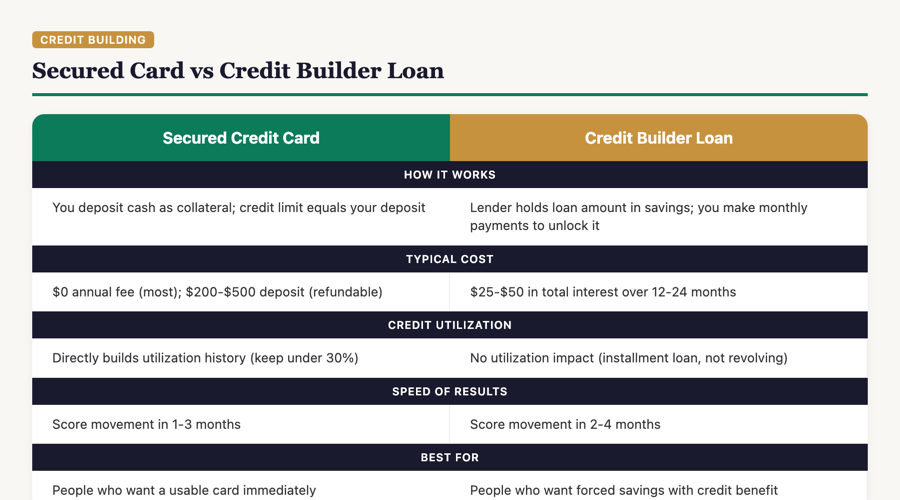
| Factor | Secured Credit Card | Credit Builder Loan |
|---|---|---|
| Upfront cost | Refundable deposit ($200-$500) | No upfront cost (payments build savings) |
| Monthly cost | Annual fee ($0-$49) + any interest on balances | Fixed monthly payment ($25-$100) |
| FICO factors reported | Payment history + utilization | Payment history + credit mix |
| Time to see score impact | 1-3 months | 3-6 months |
| Money back at end | Deposit returned if account closed in good standing | Savings released minus interest/fees |
| Ongoing credit access | Yes (revolving credit line) | No (installment loan) |
| Upgrade path | Many issuers upgrade to unsecured card | Loan ends; apply for credit card next |
| Best for | People who can manage a credit card responsibly | People who want forced savings + credit building |
How Much Does Each Option Actually Cost?
A secured credit card costs $0 in interest if you pay the full balance each month and your card has no annual fee. A credit builder loan costs the total interest paid over the loan term, which typically ranges from $15 to $80 depending on the plan. The secured card is cheaper if you use it responsibly.
Some secured cards charge an annual fee between $25 and $49. Others, like the Discover it Secured and Capital One Platinum Secured, charge no annual fee at all. If you carry a balance, the APR on secured cards runs between 20% and 28%, which makes them expensive revolving debt.
Credit builder loans from Self charge interest that amounts to roughly $15 to $80 over the life of the loan depending on the term and amount. Credit unions may offer lower rates. The hidden cost is opportunity cost: your money is locked up for the full term. With a secured card, your deposit is refundable once you close or upgrade.
Can You Use Both at the Same Time?
Yes, and using both simultaneously is actually the most effective strategy. Having a revolving account (credit card) and an installment account (credit builder loan) at the same time improves your credit mix, which accounts for 10% of your FICO score. This combination gives the scoring model the maximum amount of data.
A study from the CFPB found that consumers with both revolving and installment accounts tend to have higher credit scores than those with only one type. The combination shows lenders you can manage different forms of credit responsibly.
If your budget allows both a $200 secured card deposit and a $25 monthly credit builder payment, running them in parallel is the fastest path to a solid credit score. If you can only afford one, start with the secured card. For more on using rent payments to build credit alongside these tools, see our article on whether rent payments actually build credit.
What Should You Watch Out For?
The biggest risk with a secured credit card is treating it like free money and carrying a balance at 25% APR. The biggest risk with a credit builder loan is missing payments, which defeats the entire purpose and damages your score instead of building it.
Before opening a secured card, confirm the issuer reports to all three major bureaus. Some smaller issuers only report to one or two, which limits your credit-building reach. Also verify the card offers a path to upgrade to an unsecured card after 6 to 12 months of responsible use.
For credit builder loans, read the fee schedule carefully. Some programs charge administrative fees on top of interest. Calculate the total cost before committing. Your goal is building credit, not enriching a fintech company.
Read our research methodology to understand how we evaluate and compare financial products on this site.
Frequently Asked Questions
Do secured credit cards hurt your credit score?
Opening a secured card triggers a hard inquiry, which may temporarily lower your score by a few points. But responsible use builds your score quickly, far outweighing the initial dip within a couple of months.
How long until a credit builder loan improves my score?
Most people see initial score movement after three to six months of on-time payments. The full impact appears after the loan term ends, because longer payment history and completed accounts both carry weight.
Can I get my secured card deposit back?
Yes. When you close the account in good standing or the issuer upgrades you to an unsecured card, your full deposit is returned. Pay off any remaining balance first.
Do credit builder loans require a credit check?
Most credit builder loans use a soft pull or no credit check at all, since the lender takes minimal risk. The money stays in a locked account until you finish paying.
Which option is better for someone with bad credit vs. no credit?
For no credit at all, either works well. For bad credit with negative marks, a credit builder loan may be easier to qualify for since some secured card issuers still check your history and may decline applications with recent defaults.
Sources
- Consumer Financial Protection Bureau — Secured Credit Cards
- myFICO — What’s in Your FICO Score (checked when I last reviewed)
- Self — Credit Builder Account Plans
- FDIC — Deposit Insurance
MyMomToken.com is not a bank, credit bureau, or financial advisor. This content is for educational purposes only. Consult a qualified financial professional for advice specific to your credit situation.