
You can generate a FICO score in as little as six months after opening your first credit account, but reaching a “good” score (670 or above) typically takes 12 to 24 months of consistent on-time payments and low utilization. VantageScore can generate a score within one to two months of your first reported account. The timeline depends on which tools you use and how disciplined you are.
How Long Before You Get a Credit Score at All?
FICO requires at least one account that has been open for six months and at least one account reported to the bureaus within the last six months to generate a score. VantageScore 3.0 and newer can produce a score after just one month of reported activity. Most people starting from zero see their first score within three to six months.
According to myFICO.com, the FICO scoring model needs a minimum amount of data before it can calculate a score. That means if you open a secured credit card today, the earliest you could have a FICO score is roughly six months from now. VantageScore is faster because its model requires less history.
The credit bureaus themselves do not generate scores. They collect data. The scoring models (FICO and VantageScore) run calculations on that data. Your timeline depends on which model a lender checks. Most mortgage and auto lenders use FICO. Many credit card apps and free score tools use VantageScore.
What Does the Credit Building Timeline Actually Look Like?
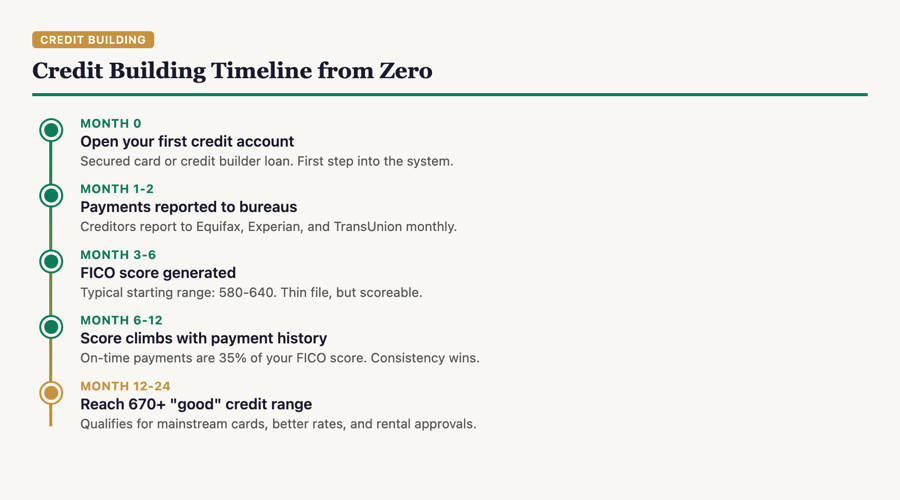
Month one to three: your first account gets reported but FICO cannot score you yet. Month three to six: VantageScore may generate your first score. Month six: FICO generates your first score, likely in the 500 to 650 range. Month 12 to 24: with consistent behavior, your score climbs into the 670-plus “good” range.
| Time Frame | What Happens | Expected Score Range |
|---|---|---|
| Month 1-2 | First account reported to bureaus; VantageScore may generate | No FICO yet; VantageScore 500-600 |
| Month 3-6 | Payment history accumulates; FICO becomes calculable | FICO 500-650 |
| Month 6-12 | On-time payments stack; utilization patterns establish | FICO 620-680 |
| Month 12-18 | Credit history length starts helping; possible upgrade to unsecured card | FICO 660-720 |
| Month 18-24 | Established history; mix of account types adds value | FICO 680-740+ |
| Year 3+ | Mature credit file; length of history and perfect payment record compound | FICO 720-780+ |
These ranges assume consistent on-time payments, utilization below 30%, and no negative marks. One missed payment during the first year can set you back significantly because you have no positive history to offset it.
Which FICO Score Factors Matter Most When Starting from Zero?
Payment history (35%) and amounts owed (30%) dominate your FICO score and are the only factors you can meaningfully influence in the first year. Length of credit history (15%) works against you early on. Credit mix (10%) and new credit (10%) are minor but become relevant once you add a second account type.
According to myFICO.com, payment history is the single largest factor. One late payment reported in your first six months is devastating because it represents a 100% delinquency rate on your thin file. By contrast, one late payment after three years of perfect history has a much smaller impact proportionally.
Amounts owed, specifically credit utilization, is the second largest factor. Keeping your secured card balance below 30% of the limit is the standard advice. Below 10% is better. Zero utilization can actually lower your score slightly because it gives the model no spending behavior data to evaluate.
For a detailed breakdown of tools that report to the bureaus, see our guide to building credit with fintech apps.
What Is the Fastest Way to Build Credit from Scratch?
The fastest approach combines a secured credit card, a credit builder loan, and authorized user status on someone else’s account. This triple strategy gives the scoring model three accounts, two account types, and multiple payment data points from day one. Some people using this method reach a 700+ score within 12 months.
Here is the practical playbook:
- Open a secured credit card with a $200 to $500 deposit. Use it for one small recurring charge (a streaming subscription works well). Pay the full balance every month. This reports payment history and utilization.
- Start a credit builder loan through Self or a credit union. This adds an installment account to your credit mix and reports payment history on a different schedule.
- Become an authorized user on a family member’s credit card with a long, clean history. Their account history gets added to your credit report, instantly boosting your length of history and payment record.
Not everyone has access to the authorized user strategy. If you do, it is the single fastest way to add years of history to a thin file. If you do not, the secured card plus credit builder loan combination is the next best approach. Read our comparison of secured cards vs. credit builder loans for a deeper breakdown.
What Slows Down the Credit Building Process?
Missed payments, high utilization, applying for too many accounts at once, and closing your oldest account are the four behaviors that slow or reverse credit building progress. Even one missed payment in your first year can drop your score by 50 to 100 points on a thin file.
Hard inquiries from credit applications temporarily reduce your score by 5 to 10 points each. With a thin file, even small point drops matter. Space out new account applications by at least three to six months.
Closing your first credit account removes it from the “average age of accounts” calculation once it falls off your report (which takes about 10 years for accounts closed in good standing). Keep your first card open even if you upgrade to better cards later. The age of that account becomes one of your most valuable credit assets over time.
Does Rent or Utility Payment Reporting Speed Things Up?
Rent and utility payment reporting can help, but the impact depends on which scoring model the lender uses. FICO 8, the most widely used version, does not incorporate rent data. FICO 9, FICO 10, and VantageScore 3.0 and newer do factor in rent payments reported through services like Experian Boost or rent-reporting platforms.
According to myFICO.com, FICO 8 does not use rent payment data. This means that even if you report rent to the bureaus, a mortgage lender using FICO 8 will not see any benefit. However, credit card issuers and some landlords using VantageScore will see the positive payment history.
Our recommendation: report rent payments if your service offers it at low or no cost, but do not treat it as a substitute for a credit card or loan. It is a supplement, not a foundation. Read our detailed analysis of whether rent payments actually build credit.
For more on how we evaluate credit-building strategies, see our research methodology.
Frequently Asked Questions
Can I build credit without a Social Security number?
Yes. You can use an Individual Taxpayer Identification Number (ITIN) to open credit accounts. Some secured card issuers and credit unions accept ITINs. The credit bureaus track your file by ITIN the same way they track SSN-based files.
Do student loans help build credit?
Yes. Federal and private student loans are installment accounts reported to the credit bureaus. On-time payments build your payment history. However, student loans alone do not give you a credit mix advantage because they are only one account type.
How many credit accounts should I have?
Two to three accounts are enough to start. One revolving account (credit card) and one installment account (credit builder loan or student loan) give you a healthy credit mix. More accounts add complexity without proportional benefit early on.
Will checking my own credit score lower it?
No. Checking your own score is a soft inquiry and has zero impact on your credit. Check regularly through free tools like Credit Karma or your bank’s credit monitoring feature. Hard inquiries from applications are what lower your score.
What is a “thin file” and why does it matter?
A thin file means you have fewer than five credit accounts or less than six months of credit history. Lenders view thin files as higher risk because there is not enough data to predict repayment behavior reliably.
Does income affect my credit score?
No. Income is not a factor in FICO or VantageScore calculations. Your credit score reflects how you manage debt, not how much you earn. However, income affects your ability to qualify for credit limits and loan amounts.
Sources
- myFICO — What’s in Your FICO Score (checked when I last reviewed)
- myFICO — Understanding FICO Scores
- Consumer Financial Protection Bureau — Building Credit
- Experian — How Long to Get a Credit Score
MyMomToken.com is not a credit bureau, bank, or financial advisor. This content is for educational purposes only. Consult a qualified financial professional for personalized credit-building advice.