

The best teen bank account depends on whether a parent wants full spending controls or is ready to let a teenager manage real money independently. Custodial accounts at digital banks offer debit cards, savings goals, and parental oversight without monthly fees. Fidelity Youth Account stands out for teens who also want to learn investing, while Step and Greenlight are strongest for everyday spending controls. Every account on this list is FDIC-insured up to $250,000.
About 80% of parents say they want their kids to learn money management before college. Yet most traditional banks still treat minors as an afterthought, bundling them into joint accounts with no educational features. The fintech wave changed that. A new generation of teen-focused accounts offers debit cards, budgeting tools, and parental controls designed specifically for the under-18 crowd. Here is how the leading options compare, based on our independent research methodology.
What Types of Bank Accounts Can Minors Open?
Minors generally cannot open a bank account alone. Federal and state laws require a parent or guardian as a joint owner or custodian until the minor reaches the age of majority, which is 18 in most states.
There are three main account structures for teens. Joint accounts add a minor to a parent’s existing account, giving both parties full access. Custodial accounts (UTMA or UGMA) are owned by the minor but managed by the custodian until the child reaches the transfer age, typically 18 to 21 depending on the state. Teen-specific accounts from fintechs are technically sub-accounts linked to a parent’s main account, with configurable permissions.
The practical difference matters. A joint account gives the teen access to the parent’s full balance. A custodial account legally belongs to the minor. A fintech teen account keeps the money separate while letting the parent set spending limits, lock the card, and monitor transactions in real time.
Which Teen Bank Accounts Have No Monthly Fees?
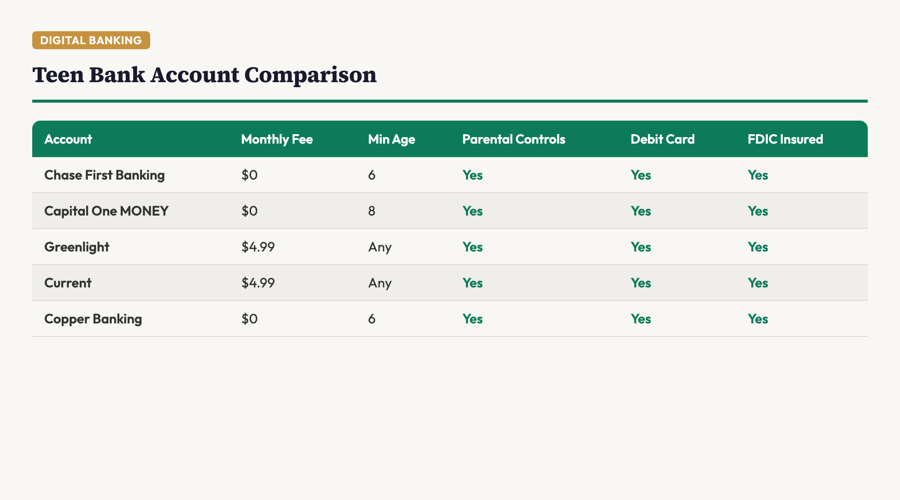
Most fintech teen accounts charge no monthly fee for the basic tier. Traditional banks are more likely to charge fees or require minimum balances. The fee structure varies significantly across providers.
| Account | Monthly Fee | Minimum Age | Debit Card | FDIC Insured | Notable Feature |
|---|---|---|---|---|---|
| Greenlight | $4.99/mo (Core) | Any age | Yes | Yes (via partner bank) | Spending controls per store category |
| Step | $0 | 13+ | Yes (Visa) | Yes (via Evolve Bank) | Reports to credit bureaus (Step Visa) |
| Fidelity Youth Account | $0 | 13-17 | Yes | Yes (cash); SIPC (investments) | Stock and ETF trading for teens |
| Chase First Banking | $0 | 6-17 | Yes | Yes (Chase Bank N.A.) | Linked to parent Chase account |
| Capital One Money (teens) | $0 | 8+ | Yes | Yes (Capital One N.A.) | No minimum balance; parent oversight |
| Copper Banking | $0 | 13+ | Yes | Yes (via Evolve Bank) | Instant money transfers from parent |
Greenlight is the only major option that charges for its base plan, though it offers the most granular parental controls. Step is free and adds a credit-building feature that reports the Step Visa card to TransUnion, which makes it unique among teen accounts. The FDIC insures deposits up to $250,000 per depositor, per institution, according to the FDIC.
Do Any Teen Accounts Help Build Credit?
Step is the only major teen banking app that reports card activity to a credit bureau. The Step Visa card is a secured spending card (not a credit card) that reports to TransUnion. This can help a teenager establish a credit file before turning 18, which gives them a head start on building a credit score through fintech apps.
Traditional teen bank accounts and most fintech alternatives do not report to credit bureaus at all. A standard debit card transaction has no impact on credit history. Parents who want their teen to start building credit should specifically look for products that report payment activity.
One important distinction: Step reports the card as a “secured card” rather than a traditional credit card. The credit-building effect is real but modest. A teen who uses Step consistently for a year will likely have a thin credit file, not a high score. That thin file still beats starting from zero at age 18.
What Parental Controls Should You Look For?
The depth of parental controls varies dramatically across providers. Greenlight leads in granularity, letting parents set spending limits by individual store or merchant category. Chase First Banking and Capital One Money offer basic controls like card locking and transaction alerts.
The controls that matter most depend on the child’s age. For younger teens (13-14), real-time spending alerts and the ability to lock the card instantly are essential. For older teens (16-17), spending category limits and savings goal features teach budgeting without micromanaging every purchase.
Every fintech teen account sends push notifications for each transaction. Most allow the parent to set daily or weekly spending caps. Greenlight and Step both let parents allocate allowance automatically on a schedule, turning the app into a built-in allowance system.
Is a Traditional Bank or a Fintech Better for a Teenager?
Traditional banks like Chase and Capital One offer stability, ATM networks, and the familiarity of a name parents already trust. Fintechs like Greenlight and Step offer better parental controls, lower fees, and features designed specifically for financial education.
The honest answer is that fintechs are better for most families right now. Traditional banks built teen products as add-ons to adult accounts. Fintechs built entire platforms around the parent-teen banking relationship. The parental dashboards, savings challenges, and educational content in apps like Greenlight are years ahead of what Chase First Banking offers.
The exception is families who already bank with Chase, Capital One, or another major institution. The convenience of keeping everything under one roof and accessing a large ATM network has real value. Chase First Banking links directly to the parent’s Chase checking account, making transfers instant and free.
For a deeper comparison of the digital banks these accounts sit on top of, see the full digital banking comparison guide.
What Happens to a Teen Account When the Child Turns 18?
This depends on the account type. UTMA and UGMA custodial accounts transfer full ownership to the child at the age of majority, which varies by state. The parent loses all control at that point, and the now-adult child can spend or withdraw everything.
Fintech teen accounts handle the transition differently. Step converts the teen account to an adult account automatically. Greenlight requires the teen to open a new account. Chase First Banking closes and the teen needs to open a standard Chase checking account. Fidelity Youth Account converts to a standard Fidelity brokerage account.
The transition matters for credit building. If a teen used Step to build credit history, that history carries over to adulthood. If they switch to an entirely new bank, they keep the credit file but lose the banking relationship. Parents should think about the 18th birthday transition before picking an account, not after.
How Do UTMA and UGMA Accounts Differ from Teen Fintech Accounts?
UTMA (Uniform Transfers to Minors Act) and UGMA (Uniform Gifts to Minors Act) accounts are legal custodial structures available at most banks. They hold assets in the minor’s name with a custodian managing them until the transfer age. UTMA accounts can hold a wider range of assets including real estate and patents. UGMA accounts are limited to financial assets like cash, stocks, and bonds.
Fintech teen accounts are not custodial accounts in the legal sense. They are sub-accounts or prepaid card programs linked to a parent’s main account. The parent retains ownership, and the teen has access only to the amount the parent loads or allocates.
For college savings or long-term wealth transfer, a UTMA account at a brokerage is better. For day-to-day spending money and financial literacy, a fintech teen account is more practical. Many families use both: a UTMA for long-term savings and a Greenlight or Step account for everyday spending.
Families exploring teen digital banking options like Chime or SoFi should note that neither currently offers a dedicated teen account, though both allow joint accounts with adults.
Frequently Asked Questions
Can a 13-year-old open a bank account without a parent?
No. Federal regulations require a parent, legal guardian, or custodian to open any bank account for a minor. Some fintech apps let the teen initiate the sign-up, but a parent must verify identity and approve the account before it activates.
Are teen bank accounts FDIC insured?
Yes, as long as the account is held at an FDIC-insured institution. Fintech teen accounts partner with FDIC-insured banks (like Evolve Bank or Bancorp Bank) to provide coverage. The FDIC insures deposits up to $250,000 per depositor, per institution.
Does Greenlight charge a monthly fee?
Yes. Greenlight Core costs $4.99 per month for up to five children. Greenlight Max costs $9.98 per month and adds investing features and identity theft protection. There is no free tier.
Can a teenager build credit with a debit card?
Standard debit cards do not report to credit bureaus and have no impact on credit scores. Step is an exception; its Visa card reports payment activity to TransUnion, which helps teens establish a credit file before turning 18.
What happens to the money in a teen account if the fintech company shuts down?
FDIC insurance protects deposits regardless of what happens to the fintech company. The insurance covers the underlying bank holding the funds. If the fintech ceases operations, the partner bank still holds and insures the deposits.
Should I open a UTMA account or a fintech teen account?
For long-term savings and wealth transfer, a UTMA account is better. For everyday spending money and teaching financial habits, a fintech teen account with parental controls is more practical. Many families use both for different purposes.
Sources
- FDIC — Deposit Insurance Coverage, fdic.gov (verified when this article was last reviewed)
- Step — Product Features and Credit Reporting, step.com
- Greenlight — Pricing and Features, greenlight.com
- Chase — First Banking Account Details, chase.com
- Fidelity — Youth Account Features, fidelity.com
- Capital One — Money Teen Account, capitalone.com
MyMomToken.com is not a bank, financial advisor, or government agency. This content is for educational purposes only. See our research methodology and disclaimer for details on how we evaluate products.